
How to Play NYT Connections: Rules, Scoring & Complete Guide
April 6, 2026
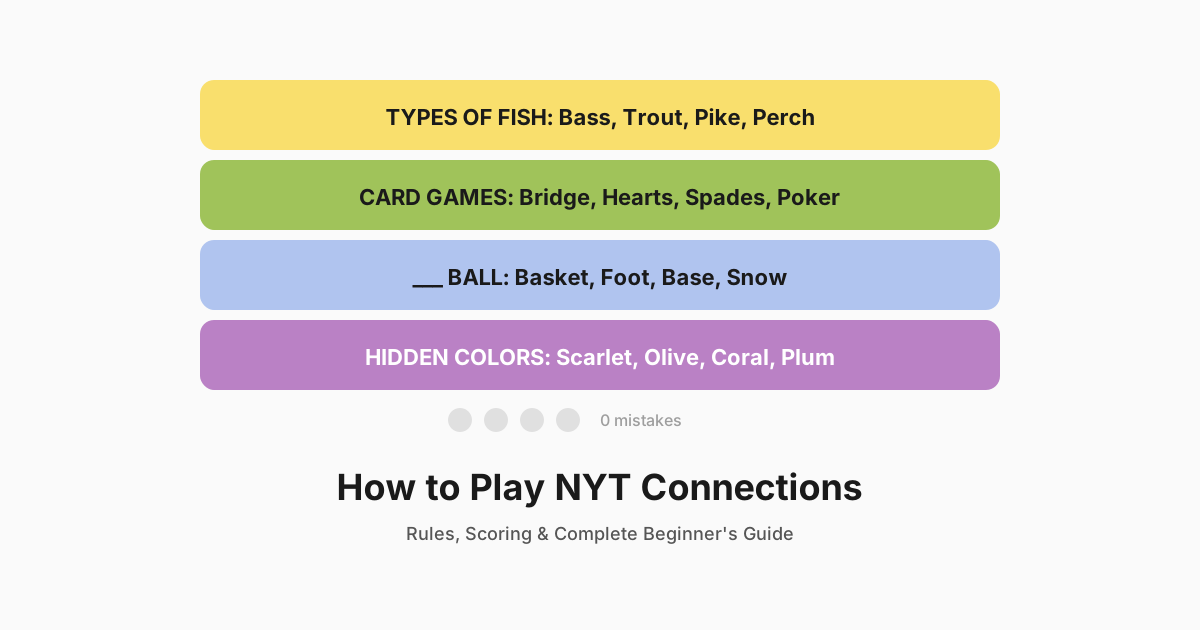
Learn how to play NYT Connections with this complete beginner's guide. Understand the rules, color-coded difficulty system, scoring, and how Connections compares to Wordle, plus tips for your first week.
Table of Contents
What Is NYT Connections?
NYT Connections is a daily word puzzle published by The New York Times. It launched in June 2023 and has since become the second-most-popular NYT word game after Wordle. As of early 2026, the NYT has published over 978 puzzles, each played by millions of people worldwide.
The concept is deceptively simple: you see 16 words on a grid and must sort them into four hidden groups of four. Each group shares a secret connection. It might be a shared category, a word pattern, or an abstract theme. The challenge is figuring out which four words belong together when many of them seem to fit into multiple groups at once.
Connections is free to play on the NYT Games website and app, and a new puzzle drops every day at midnight Eastern Time. Unlike Wordle, which tests vocabulary and letter placement, Connections tests lateral thinking, pattern recognition, and your ability to resist the traps the editors set for you.
What Are the Rules of Connections?
The rules are straightforward, which is part of what makes the game so accessible.
- You see 16 words arranged on a 4x4 grid.
- Your goal is to find 4 groups of 4 words that share a hidden connection.
- Select 4 words and hit Submit to guess a group.
- If your guess is correct, those 4 words are removed and the group is revealed with its color and category name.
- If your guess is wrong, you lose one of your 4 allowed mistakes.
- After 4 mistakes, the game is over and all groups are revealed.
- You can shuffle the grid at any time to rearrange the words. This is free and unlimited.
- You can deselect words before submitting if you change your mind.
- The game tells you if you are "one away", meaning 3 of your 4 selected words are correct but the fourth is wrong.
There is no time limit. You can take as long as you need. The only constraint is the 4-mistake limit.
What Do the Colors Mean in Connections?
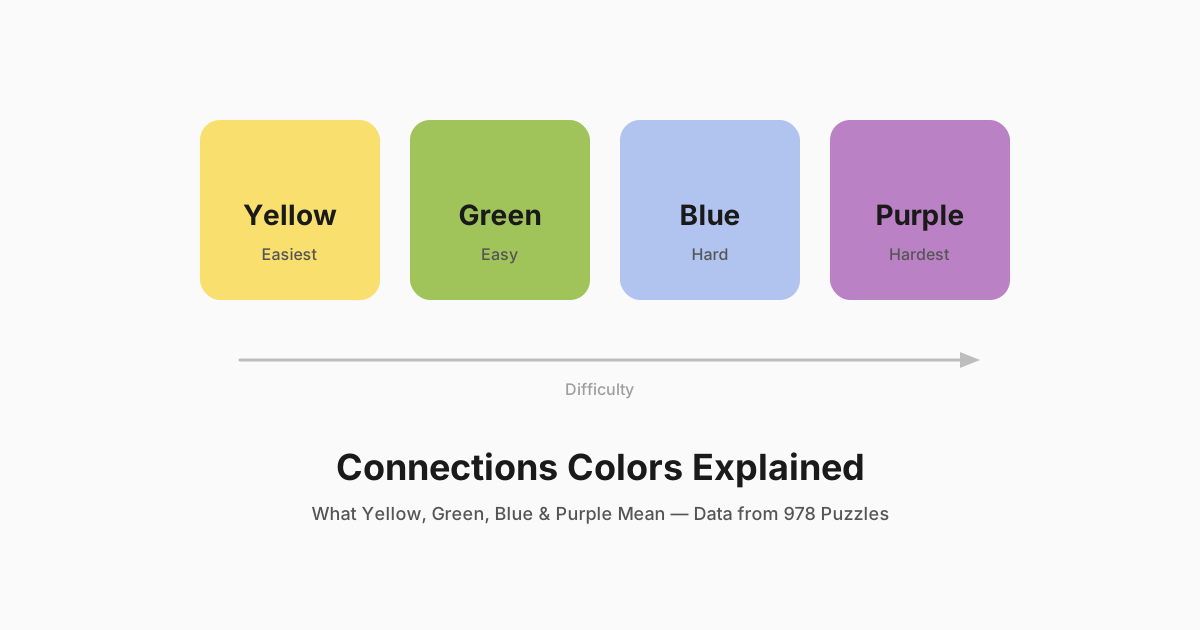
Each of the four groups is assigned a color that indicates its difficulty level. The colors are always the same:
- Yellow is theEasiest. The most obvious, straightforward grouping.
- Green isSecond easiest. Slightly more nuanced than yellow.
- Blue is theSecond hardest. Often involves more abstract connections or specific knowledge.
- Purple is theHardest. Typically features wordplay, hidden patterns, or tricky lateral thinking.
You do not see the colors until you correctly solve a group. Once solved, the group's color and category name are revealed at the top of the board.
Our analysis of 978 puzzles confirms this difficulty gradient: purple category descriptions average 35% longer than yellow ones (19 characters vs. 14), reflecting their greater complexity. Purple categories are also 96.6% unique across all puzzles, meaning the editors almost never reuse the same purple format twice. For a deep dive into what each color really means and the data behind it, see our Colors Explained article.
How Many Guesses Do You Get in Connections?
This is one of the most common points of confusion, especially for Wordle players. In Connections, you do not have a fixed number of "guesses". Instead, you have 4 allowed mistakes.
Every correct guess is free. If you identify all four groups without a single wrong submission, you have made 4 guesses and 0 mistakes. If you get three groups right but make 2 wrong guesses along the way, that counts as 2 mistakes out of your 4.
This system is fundamentally different from Wordle, where every guess (right or wrong) counts toward your limit of 6. In Connections, accuracy matters more than efficiency. You can take your time, think through each guess carefully, and only submit when you are confident. There is no penalty for slow play, only for wrong play.
What Does 'One Away' Mean in Connections?
When you submit a guess and see the message "One away...", it means exactly 3 of your 4 selected words belong to the same group, but the fourth word does not.
This is one of the most useful signals in the game. It tells you that your core instinct was right. You just need to figure out which word does not belong and swap it for the correct one.
The best approach after a "one away" alert is to look at your 4 words and ask: which one feels like the weakest fit? Which one could plausibly belong to a different group? Try swapping that word with other available words on the board. Since you know 3 of your 4 are correct, you only need to test a handful of alternatives rather than starting from scratch.
Note that "one away" only appears when exactly 3 of 4 words match a single group. If 2 of your words belong to one group and 2 to another, you will not see the message. You will just get a regular incorrect guess.
How Does Scoring Work in Connections?
Connections does not have a traditional point-based scoring system. Instead, your result is represented by an emoji grid that you can share on social media, group chats, or messaging apps.
The grid shows which groups you solved and in what order, using colored squares:
- Yellow squares for the yellow group
- Green squares for the green group
- Blue squares for the blue group
- Purple squares for the purple group
Each row of 4 squares represents one of your guesses. A correct guess shows 4 squares of the same color. An incorrect guess shows a mix of colors, revealing which groups your selected words actually belonged to.
The ideal result is a clean grid with 4 rows of matching colors and 0 mistakes. Many players aim for a "perfect" game, solving all four groups in order from yellow to purple without a single wrong guess. Others compete to solve the puzzle in as few total guesses as possible.
The shared grid is spoiler-free: it shows your performance pattern without revealing any words or category names, so you can discuss results without ruining the puzzle for others.
How Is Connections Different from Wordle?
Both games are published daily by the NYT, both are free, and both have become part of millions of people's morning routines. But they test completely different skills.
Format: Wordle gives you a single 5-letter word to guess. Connections gives you 16 words to sort into 4 groups.
Mistakes: Wordle allows 6 total guesses (right or wrong). Connections allows 4 mistakes, and correct guesses are free.
Skills tested: Wordle tests vocabulary, spelling, and letter-position logic. Connections tests categorization, lateral thinking, and resistance to deliberate misdirection.
Difficulty curve: Wordle's difficulty varies by the obscurity of the target word. Connections has a built-in difficulty gradient (yellow through purple) in every single puzzle.
Time pressure: Neither game has a timer, but Wordle games tend to be shorter (most people finish in under 5 minutes). Connections can take longer because the 16-word grid requires more analysis.
Sharing: Both games use an emoji grid for spoiler-free sharing. Wordle's grid shows green/yellow/gray squares for each guess. Connections shows colored squares for each group you identified.
If you are a Wordle player trying Connections for the first time, the biggest adjustment is the shift from linear guessing (one word at a time) to spatial pattern recognition (seeing relationships across 16 words simultaneously).
Tips for Your First Week of Connections
If you are new to Connections, these beginner strategies will help you build confidence before diving into advanced techniques.
Start by scanning for the obvious group. Every puzzle has one group (yellow) designed to be straightforward. Before trying anything else, look for 4 words that obviously belong together: common synonyms, items in a clear category, or a recognizable pattern.
Use the shuffle button early and often. Rearranging the grid breaks visual habits and reveals patterns you might miss in the default layout. There is no limit and no penalty.
Do not rush. There is no timer. Take your time, especially as a beginner. Read all 16 words carefully before making your first guess.
Pay attention to the "one away" signal. If you get this message, you are very close. Think about which of your 4 words is the weakest link and try swapping it.
Accept that purple will be hard. The purple category is meant to be tricky even for experienced players. If you cannot figure it out, solve the other three groups first and let purple reveal itself by elimination.
Review your results. After each puzzle, look at the groups you missed and think about why. Pattern recognition improves with deliberate review. For a deeper set of 10 data-backed strategies, read our Connections Strategy Guide.
Where to Get Hints When You're Stuck
Getting stuck is normal, especially in your first few weeks. Rather than burning through your 4 mistakes with random guesses, progressive hints can nudge you in the right direction without spoiling the answer.
Our daily Connections hints, published every morning, use a 5-level progressive reveal system:
- Level 1:A general direction for each group (no specific words mentioned)
- Level 2:Thematic clues about what each category involves
- Level 3:The actual category names revealed
- Level 4:One anchor word per group to start you off
- Level 5:The full solution with all words in each group
You can stop at any level once you have enough information to solve the puzzle yourself. Most players find that Level 1 or 2 is enough to get unstuck without feeling like the answer was handed to them.
We also maintain a full Connections archive where you can browse all 978+ past puzzles, review their categories and solutions, and practice your pattern recognition.
Frequently Asked Questions
You get 4 allowed mistakes, not a fixed number of guesses. Correct guesses are free and unlimited. Only wrong submissions count against your 4-mistake limit. This is different from Wordle, where every guess counts toward the limit of 6.
They test different skills, so difficulty depends on your strengths. Wordle tests vocabulary and letter logic. Connections tests categorization and lateral thinking. Many players find Connections harder because the deliberate inclusion of trap words creates ambiguity that Wordle does not have. The purple category, in particular, is designed to challenge even experienced players.
The official NYT Connections game releases one new puzzle per day, and each puzzle can only be played once. However, you can browse past puzzles in our Connections archive to practice and review previous solutions.
A new Connections puzzle is published every day at midnight Eastern Time (ET). If you are in a different time zone, the puzzle may appear late in the evening or early in the morning depending on the offset.
Each Connections puzzle is assigned a sequential number starting from the game's launch in June 2023. The puzzle number simply indicates which daily puzzle it is in the series. Higher numbers are more recent puzzles.
The official NYT site only offers the current day's puzzle. To browse and review past puzzles, you can use our Connections archive, which contains all 978+ puzzles with their categories, words, and full solutions.
Keep Reading
NYT Connections Colors Explained: What Yellow, Green, Blue & Purple Mean
Every NYT Connections puzzle uses four color-coded groups ranked by difficulty. We analyzed 978 puzzles to show exactly what each color means, which categories appear most, and how to use the color system to your advantage.
NYT Connections Strategy: 10 Data-Backed Tips to Win More Puzzles
Improve your NYT Connections solve rate with 10 strategies backed by data from 978 puzzles. Learn which category types appear most, how to handle trap words, and why starting with yellow gives you the best odds.
Need today's Connections hints?
Progressive clues revealed one level at a time, category hints, and full answers.
Today's Connections Hints