
NYT Connections Colors Explained: What Yellow, Green, Blue & Purple Mean
April 6, 2026
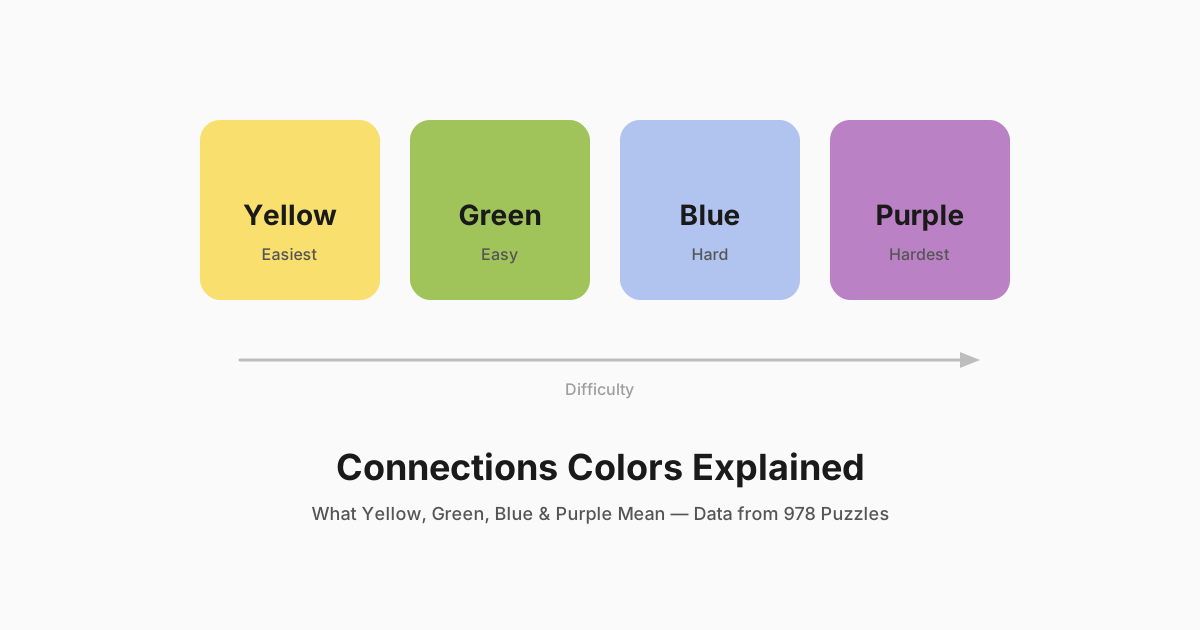
Every NYT Connections puzzle uses four color-coded groups ranked by difficulty. We analyzed 978 puzzles to show exactly what each color means, which categories appear most, and how to use the color system to your advantage.
Table of Contents
What Do the Colors Mean in NYT Connections?
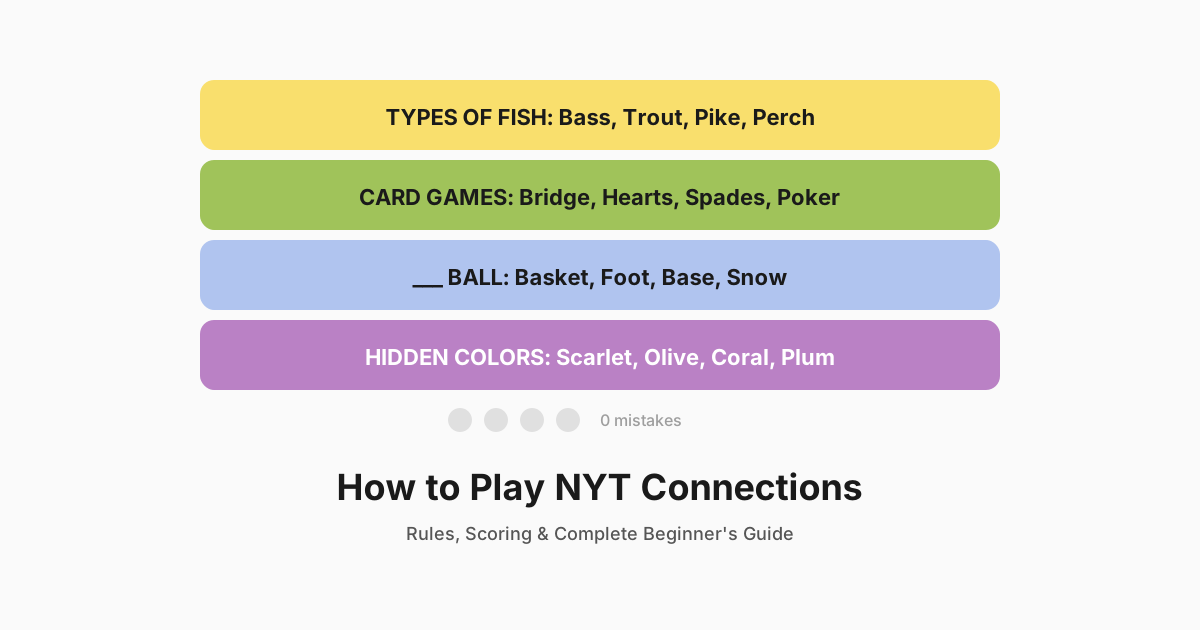
Every NYT Connections puzzle presents 16 words arranged in a 4×4 grid. Your job is to sort them into 4 groups of 4, and each group is assigned a color: yellow, green, blue, and purple. These colors are not random. They represent a fixed difficulty gradient from easiest to hardest.
Yellow is the most accessible group, designed so that most players can spot it relatively quickly. Green is a step up. Blue requires sharper pattern recognition or more specific knowledge. Purple is the hardest, often demanding lateral thinking, wordplay, or deep cultural references.
Across 978 puzzles and 3,912 total category groups in our archive, each color consistently signals a specific difficulty tier. This system was put in place by editor Wyna Liu and the NYT puzzle team when the game launched in June 2023, and it has remained unchanged ever since. The editors design each puzzle so that yellow contains the most obvious grouping, while purple requires the most creative reasoning to crack.
Understanding what the colors mean is the first step toward solving more consistently. For practical tips on how to leverage this system, see our strategy guide.
How Hard Is Each Color? Yellow Through Purple, by the Numbers
To measure how each color's difficulty actually plays out, we analyzed category name length across all 978 puzzles. Longer category descriptions tend to correlate with more abstract or convoluted groupings, giving us a concrete proxy for complexity.
The results are clear. Yellow categories average 14 characters in their description. Green averages 15 characters. Blue averages 19 characters. Purple averages 19 characters. That means purple and blue category descriptions are roughly 35% longer than yellow ones.
What does this look like in practice? Yellow categories tend to be single, clear concepts, things like "Types of fish" or "Shades of blue." The pattern is immediately recognizable once you see it. Green categories are similar but slightly less obvious, perhaps requiring one extra mental step. Blue and purple categories, by contrast, often involve multi-step reasoning or compound descriptions like "Words that become a new word when you add 'S' to the front."
The jump from green to blue is the steepest increase in complexity. Green and yellow feel like they belong to the same family of straightforward categories, while blue and purple occupy a distinctly harder tier. It is also worth noting that across all 3,912 categories, 90% are completely unique (3,531 distinct names), meaning the puzzle editors rarely repeat themselves and constantly push for fresh ideas.
Yellow
14 avg chars
Green
15 avg chars
Blue
19 avg chars
Purple
19 avg chars
What Makes the Purple Category So Difficult?
Purple is the most feared color in Connections for good reason. It typically involves wordplay, hidden patterns, letter manipulation, or obscure cultural references that demand a different kind of thinking than the other three groups.
From our analysis of 978 puzzles, 96.6% of purple categories are completely unique (945 out of 978). That is the highest uniqueness rate of any color. In practical terms, this means you cannot rely on past purple categories to predict future ones. The editors treat purple as their creative playground, inventing new formats rather than recycling old ones.
Common purple category types include wordplay and letter manipulation (e.g., "Words that contain a body part"), hidden word patterns (e.g., "Each word hides a planet"), pop culture deep cuts, and multi-step associations that require chaining two or more logical leaps together.
Purple categories also tend to feature "trap words", words deliberately placed to look like they belong in an easier group. When you see a word that seems like an obvious fit for yellow or green, it may actually be bait designed to lure you away from the correct purple grouping. Across all puzzles, 55 categories (about 6% overall) involved homophones or sound-based wordplay, and these disproportionately appear in purple.
To illustrate just how wild purple can get, here are three real examples from the archive: "PROPER NOUNS IN BROADWAY MUSICAL TITLES THAT ARE SPOKEN PHRASES" (63 characters), "WORDS THAT BECOME A NEW WORD WHEN YOU REMOVE THE FIRST TWO LETTERS," and "MEMBER OF A TEAM WITH THE MOST CHAMPIONSHIPS IN THEIR RESPECTIVE SPORTS". That last one is the longest category in the entire archive at 71 characters.
What Types of Categories Appear Most Often?
We categorized every group across 978 puzzles by its structural type to find out which formats the editors favor most. The patterns are striking.
Blank-fill categories (like "ROLLER ___" or "___ QUEEN") appear in 330 puzzles, making up roughly 34% of all puzzles. These are the single most common category type and are often assigned to yellow or green because the pattern is recognizable once you spot it. If you see several words that could follow or precede a common word, you are likely looking at a blank-fill group.
"Starting with" categories (where all words share a common prefix or starting pattern) appear in 253 puzzles (about 26%). These can range from easy (all words start with "B") to tricky (all words start with a hidden word like "car" ( carpet, cartoon, cardinal).
Homophones and sound-based wordplay show up in 55 puzzles (roughly 6%). These require you to think about how words sound rather than what they mean, which is why they tend to land in blue or purple.
"Ending in" or "ending with" patterns appear in 36 puzzles (about 4%). The remaining roughly 30% of categories use unique, one-off formats like synonym groups, thematic associations, pop culture references, or multi-step logical connections.
Understanding these patterns is one of the most effective strategies for solving Connections. When you recognize a structural type, you can quickly test whether the remaining words fit that template.
Which Words Appear Most Frequently Across Puzzles?
Our analysis of all 15,648 word placements across 978 puzzles reveals 7,214 unique words. But some words keep coming back, and the reason is revealing.
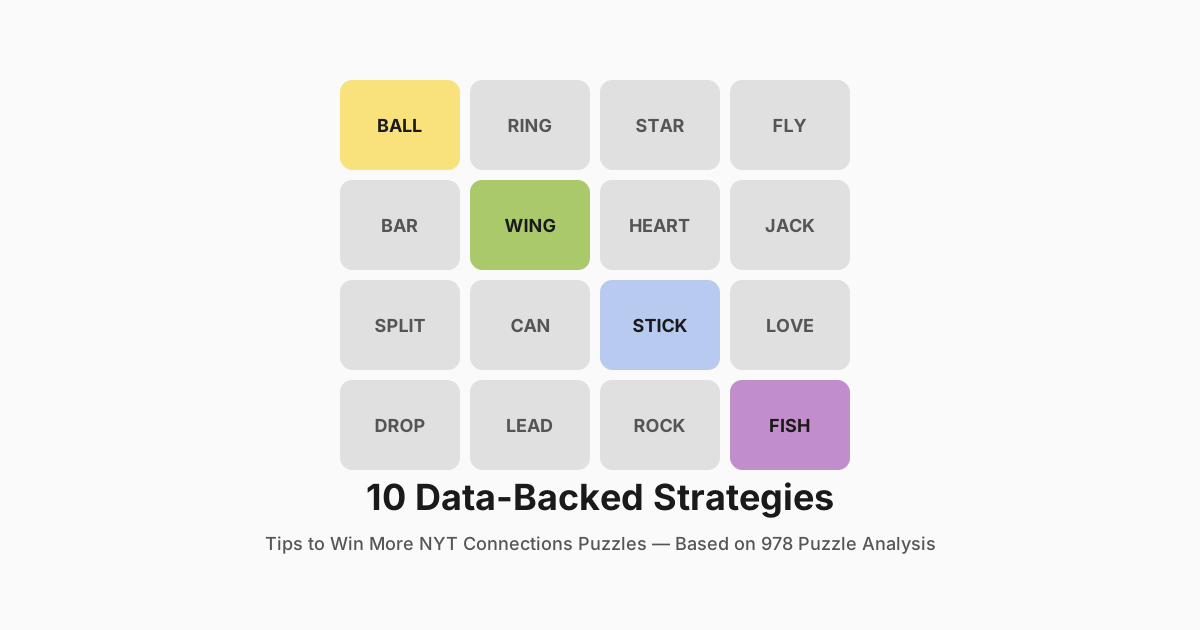
The 20 most-repeated words are: "ball" (26 appearances), "ring" (20), "bar" (19), "wing" (19), "split" (17), "star" (17), "fly" (17), "heart" (17), "can" (16), "stick" (16), "love" (16), "jack" (16), "copy" (15), "drop" (15), "lead" (15), "egg" (15), "baby" (15), "rock" (15), "blue" (15), and "fish" (15).
Notice the pattern: every single one of these is a short, multi-meaning word. "Ball" can mean a formal dance, a sphere, a baseball pitch, or part of a compound word like basketball, eyeball, or ballpark. "Ring" could refer to jewelry, a boxing ring, a phone ringing, or a tree ring. "Lead" can be a metal, a verb meaning to guide, or the lead in a play.
The editors use these words precisely because they create ambiguity. You cannot immediately tell which group a word like "ring" belongs to without considering all four categories simultaneously. This is by design: these versatile, multi-meaning words are the engine of the puzzle's difficulty. When you see several of these high-frequency words on the board, expect more overlap between groups and more opportunities for misdirection.
ball
26
ring
20
bar
19
wing
19
split
17
star
17
fly
17
heart
17
can
16
stick
16
love
16
jack
16
copy
15
drop
15
lead
15
egg
15
baby
15
rock
15
blue
15
fish
15
How Unique Are Connections Categories?
One of the most impressive things about NYT Connections is its creative diversity. Across 3,912 total category groups spanning 978 puzzles, 3,531 are completely unique, with a 90.3% uniqueness rate.
Breaking it down by color reveals an interesting gradient. Yellow has 925 unique categories out of 978 (94.6%). Green has 937 unique (95.8%). Blue has 932 unique (95.3%). Purple has 945 unique (96.6%).
Purple's highest uniqueness rate confirms what players intuitively feel: the hardest category is also the most unpredictable. The editors consistently invent new purple formats rather than recycling old ones, which is why purple feels fresh and surprising even after hundreds of puzzles.
The relatively lower uniqueness in yellow (94.6%) makes sense when you think about it. Straightforward categories like "Types of ___" or synonym groups naturally repeat more often because there are fewer ways to construct a simple, obvious grouping. When your goal is to create something most players will immediately recognize, you are working within a narrower design space.
The takeaway for players is this: while you can learn general patterns (wordplay, hidden words, blank-fill) and use them to build intuition, you should never expect to see the exact same category twice. The editors are remarkably disciplined about keeping things fresh, which is a big part of why the game remains compelling puzzle after puzzle.
Yellow
94.6 %
Green
95.8 %
Blue
95.3 %
Purple
96.6 %
How to Use Color Difficulty to Your Advantage
Understanding the color system is not just trivia. It changes how you should approach every puzzle. Here are the main strategic implications.
Start with yellow when you are confident. Since yellow is designed to be the most obvious group, spotting it first gives you a guaranteed correct answer and removes 4 words from the board. With only 12 words remaining, the other three groups become easier to see. Many experienced players scan the board specifically for the "easy" grouping before considering anything else.
Use elimination for purple. Rather than trying to solve purple directly, solve the other three groups first. With only 4 words left, the purple group reveals itself by default. This avoids the risk of burning mistakes on the hardest category. Since you only get 4 mistakes before the game ends, protecting those guesses by saving purple for last is one of the highest-value strategies available.
Watch for color misdirection. The editors intentionally place words that look like they belong in yellow or green but actually belong in blue or purple. When a word seems "too obvious" for an easy group, consider whether it might be a trap. This is especially common with multi-meaning words like "ball," "ring," and "star", the most frequently used words in the entire archive.
Use the shuffle button. If you are stuck between colors, shuffling the grid breaks visual patterns your brain has locked onto and can reveal new groupings you were not seeing before. There is no penalty for shuffling, so use it liberally.
For more detailed strategies, including the one-word focus method and how to handle "one away" alerts, see our Connections Strategy Guide. For a complete walkthrough of the rules and mechanics, check out How to Play Connections.
Frequently Asked Questions
Yes. The NYT Connections editors consistently design yellow as the most straightforward group. Our analysis of 978 puzzles confirms that yellow categories average the shortest and simplest descriptions at 14 characters, compared to 19 for purple. However, 'easiest' is relative, and some yellow categories still trip up players who overthink them.
Purple marks the hardest category in each Connections puzzle. Purple groups typically involve wordplay, hidden patterns, letter manipulation, or obscure cultural references. Our data shows 96.6% of purple categories are completely unique, meaning the editors rarely reuse purple formats, making them the most unpredictable color.
Yes. The color-to-difficulty mapping never changes: yellow is always easiest, green is second, blue is third, and purple is always hardest. What changes is the specific type of category assigned to each color. The difficulty within each color tier can vary from day to day, but the relative order stays fixed.
Green is the second-easiest group and typically uses clear, recognizable patterns like synonym sets or obvious thematic links. Blue is the second-hardest and tends to involve more abstract associations, less common vocabulary, or categories that require specific knowledge. Our data shows both blue and green average 15-19 character descriptions, but blue categories more often rely on cultural or specialized knowledge.
Not directly. The colors are only revealed after you correctly identify a group. However, experienced players can often estimate difficulty by scanning the 16 words for multi-meaning words (which signal harder puzzles) and obvious groupings (which signal an easier yellow category). If several words like 'ball,' 'ring,' or 'star' appear, expect more overlap and misdirection.
Keep Reading
NYT Connections Strategy: 10 Data-Backed Tips to Win More Puzzles
Improve your NYT Connections solve rate with 10 strategies backed by data from 978 puzzles. Learn which category types appear most, how to handle trap words, and why starting with yellow gives you the best odds.
How to Play NYT Connections: Rules, Scoring & Complete Guide
Learn how to play NYT Connections with this complete beginner's guide. Understand the rules, color-coded difficulty system, scoring, and how Connections compares to Wordle, plus tips for your first week.
Need today's Connections hints?
Progressive clues revealed one level at a time, category hints, and full answers.
Today's Connections Hints