
NYT Connections Strategy: 10 Data-Backed Tips to Win More Puzzles
April 6, 2026
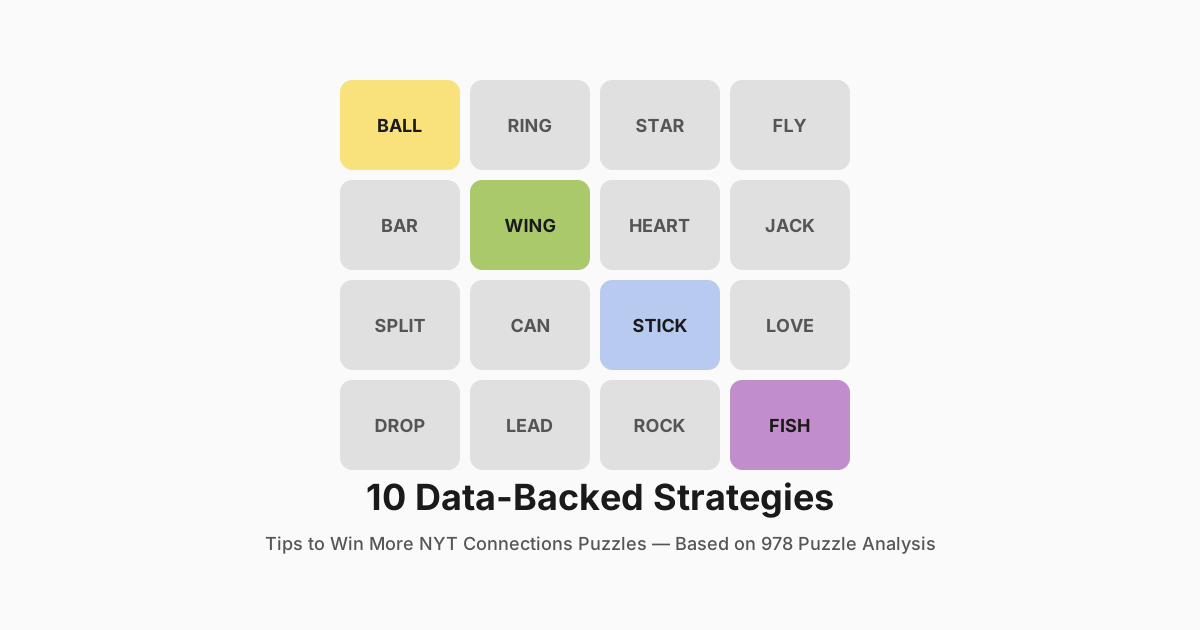
Improve your NYT Connections solve rate with 10 strategies backed by data from 978 puzzles. Learn which category types appear most, how to handle trap words, and why starting with yellow gives you the best odds.
Table of Contents
Why Is Connections Harder Than It Looks?
Connections looks simple: find four groups of four among 16 words. But the math tells a different story. There are 10,518,300 possible ways to divide 16 words into 4 groups of 4 (calculated as 16! / (4!)^4 / 4!). Only one of those combinations is correct. Random guessing gives you a 0.0000095% chance of solving the puzzle, roughly 1 in 10.5 million. Even your first guess (picking 4 words from 16) has a 1-in-1,820 chance of being correct by pure luck.
The editors stack the odds further by including trap words, words that plausibly fit into multiple groups. Our analysis of 978 puzzles shows the 20 most-used words (like "ball," "ring," and "bar") each appear 15-26 times precisely because they have multiple meanings. Every word in the grid is there to create ambiguity, not to help you.
That is why you need a systematic approach. These ten strategies, drawn from patterns in our archive of 978 puzzles, will dramatically improve your consistency.
What Is the Best Strategy for NYT Connections?
The single most effective strategy is process of elimination combined with pattern recognition. Rather than trying to solve all four groups at once, focus on one group at a time, starting with the one you are most confident about.
Here is the method in three steps. Step 1: Scan all 16 words and look for an obvious grouping, usually the yellow (easiest) category. Step 2: Once you identify a confident group, submit it. This removes 4 words and makes the remaining 12 easier to parse. Step 3: Repeat, working your way from high-confidence to low-confidence groups.
The reason this works connects to the data: 34% of all puzzles contain blank-fill categories (like "___ QUEEN" or "FIRE ___"), which are often among the easiest to identify. If you can spot one of these patterns early, you immediately reduce the puzzle to 12 words, where overlapping trap words become far less confusing. For a detailed breakdown of all category patterns, see our Colors Explained article.
Should You Start with Yellow or Purple?
This is the biggest strategic debate in the Connections community. Here is the data-backed answer.
Starting with yellow is the safer approach. Yellow categories have the simplest descriptions (averaging 14 characters vs. purple's 19) and are designed to be the most obvious group. Solving yellow first gives you a confirmed correct answer with minimal risk, which removes 4 words and makes the board clearer.
Starting with purple is the high-risk, high-reward play. Because purple is the hardest, identifying it first means you solved the trickiest part before the board gets muddled. But the risk is substantial: if your purple guess is wrong, you burn a precious mistake on the group with the highest ambiguity.
Our recommendation: Start with yellow unless you are extremely confident about purple. In 978 puzzles, 96.6% of purple categories are unique formats, meaning you cannot rely on past experience to predict them. Yellow's simpler, more predictable patterns (94.6% unique, but with more familiar structures) make it the statistically safer first guess.
How Do You Spot Overlapping Words?
Overlapping words, meaning words that seem to fit in multiple groups, are the primary trap in Connections. The editors deliberately include them to create uncertainty.
Our word frequency analysis reveals why certain words keep appearing. The top 5 most-used words are "ball" (26 appearances), "ring" (20), "bar" (19), "wing" (19), and "split" (17). Every one of these is a short, common word with numerous meanings. "Bar" could fit a group about drinks, legal terms, gymnastics, music, or compound words.
When you spot one of these highly versatile words, do not try to place it immediately. Instead, work backward: identify which group it definitely cannot belong to, and narrow down from there. The best approach is the one-word focus method, pick the most ambiguous word on the board, list every possible group it could fit, then cross-check those groups against the other 15 words to find the one that makes a complete set of four.
What Are the Most Common Category Types?
Knowing which category types appear most frequently gives you a pattern-recognition advantage. From our analysis of 978 puzzles and 3,912 category groups:
- Blank-fill ("___") categories: 330 puzzles (34%). Examples: "ROLLER ___", "___ QUEEN", "FIRE ___". These are the most common and often the easiest to spot because the pattern reveals itself once you test a few words.
- "Starting with" categories: 253 puzzles (26%). All words share a prefix, initial letter pattern, or structural similarity.
- Synonym/definition groups are common across all colors, these group words that mean the same thing or relate to the same concept.
- Homophones and wordplay: 55 puzzles (6%). Words that sound like something else or contain hidden words. These overwhelmingly appear in blue and purple.
- "Ending with" patterns: 36 puzzles (4%). Words sharing a suffix or ending sound.
- Pop culture and proper nouns appear across all colors but especially in blue and purple, requiring specific knowledge.
Recognizing these patterns instantly narrows your options. If you spot a potential blank-fill pattern, test it first, there is a 1-in-3 chance that at least one category in today's puzzle uses this format.
Blank-fill
34 %
Starting with
26 %
Synonyms
18 %
Homophones
6 %
Ending with
4 %
Other
12 %
How Does the Shuffle Button Help?
The shuffle button is one of the most underused tools in Connections. It rearranges the 16 words randomly on the grid. This matters because of a psychological effect called anchoring, once you see words next to each other, your brain assumes they are related. Shuffling breaks those false associations and can reveal genuine groupings you missed.
Use shuffle in two situations. When you are stuck: If you have been staring at the same arrangement for more than 30 seconds, shuffle. The new layout often triggers fresh connections. After solving a group: When 4 words disappear, the remaining 12 rearrange automatically, but hitting shuffle again can reveal patterns among the new arrangement.
There is no limit to how many times you can shuffle, and it costs nothing, no penalty, no lost guesses. Make it part of your routine.
What Does 'One Away' Mean and How Should You React?
When you submit a guess and see the "One away..." message, it means exactly 3 of your 4 selected words belong to the same group, but the fourth does not. This is extremely valuable information, you are close, you just need to swap one word.
The best reaction is systematic: look at your 4 selected words and ask which one is the weakest fit. Try swapping it with each remaining word on the board until you find the correct combination. Do not guess randomly after a "one away" signal. Since you know 3 of 4 are correct, you only need to test a small number of alternatives.
Typically, the wrong word is the most ambiguous one, the one that could plausibly fit into another group. This is where knowing the color difficulty system helps: if you are solving a green group and one of your words seems "too tricky" for green, it might actually belong in blue or purple.
How Do You Solve the Purple Category?
Purple is the hardest category for a reason: 96.6% of purple categories are completely unique formats that you have never seen before. The average purple description runs 19 characters, 35% longer than yellow's 14. And the category types that overwhelmingly appear in purple, wordplay (6% of all puzzles), hidden patterns, and multi-step associations, require lateral thinking rather than direct knowledge.
Here are three purple-specific strategies. Think in layers: Purple rarely means what it seems. If the words "mars," "mercury," "saturn," and "venus" appear, they might not be grouped as planets, they could be hidden inside compound words, song titles, or brand names. Save purple for last: When you solve yellow, green, and blue first, the remaining 4 words are automatically purple. This eliminates all guesswork. Look for the most unusual word: In most puzzles, purple contains at least one word that feels out of place on the entire grid. That word is your entry point, build the purple group around it.
How Can Past Puzzles Help You Improve?
Our archive contains 978 puzzles with 7,214 unique words across more than three years of Connections history. Reviewing past puzzles is one of the fastest ways to improve because patterns recur even when specific categories do not.
The most actionable insight from the archive: the same 20 words appear over and over because they have the most meanings. If you see "ball," "ring," "bar," "star," "fly," "heart," or "jack" in today's puzzle, expect them to be trap words placed to create ambiguity across multiple groups.
Training on past puzzles also builds your recognition of category types. After seeing dozens of blank-fill categories (34% of all puzzles), you start spotting them instantly. The same goes for homophones (6%) and "starting with" patterns (26%). You can browse our full Connections archive to practice with previous puzzles and test your pattern recognition against the actual answers.
What Mistakes Should You Avoid in Connections?
Based on the patterns in 978 puzzles, here are the most common mistakes and how to avoid them.
Guessing randomly after spotting two words that match. Two matching words are not enough, you need four. If you guess with only partial confidence, you burn a mistake. Always find at least 3 strong matches before guessing, then look for the fourth.
Ignoring blank-fill patterns. These appear in 34% of all puzzles and are usually the easiest to solve. If you do not actively scan for "___" patterns, you are missing the lowest-hanging fruit on the board.
Fixating on one interpretation. A word like "lead" can mean a metal, the verb "to lead," a pencil lead, or a dog lead. If your first interpretation does not lead to a group of four, pivot to another meaning. The editors choose multi-meaning words on purpose.
Not using shuffle. Anchoring bias is real. If you have not shuffled, you are likely seeing phantom groupings that do not exist. Shuffle early and often.
Burning mistakes on purple. Unless you are very confident, avoid guessing purple directly. The 96.6% uniqueness rate means past experience rarely helps. Solve the other three colors first and let purple reveal itself by elimination.
Frequently Asked Questions
You can make exactly 4 mistakes before the game ends. Each incorrect guess (submitting 4 words that do not form a valid group) counts as one mistake. Correct guesses do not count against you. After 4 mistakes, the puzzle is over and all groups are revealed.
Process of elimination. Start with the group you are most confident about (usually yellow), solve it to remove 4 words, then work through the remaining groups in order of confidence. This reduces ambiguity at each step and prevents wasting mistakes on harder categories.
Yes. Our analysis of 978 puzzles shows consistent structural patterns: 34% of puzzles use blank-fill categories, 26% use 'starting with' patterns, and 6% involve homophones. The color difficulty is also fixed, yellow is always easiest, purple always hardest. Learning these patterns improves your solve rate significantly.
There are 10,518,300 possible ways to divide 16 words into 4 groups of 4. Only one combination is correct. This is why random guessing has essentially zero chance of working and a systematic strategy is essential.
The official NYT site only offers the daily puzzle, but our Connections archive lets you browse all 978+ past puzzles with their categories, words, and answers. Reviewing past puzzles is an excellent way to build pattern recognition and improve your strategy.
Keep Reading
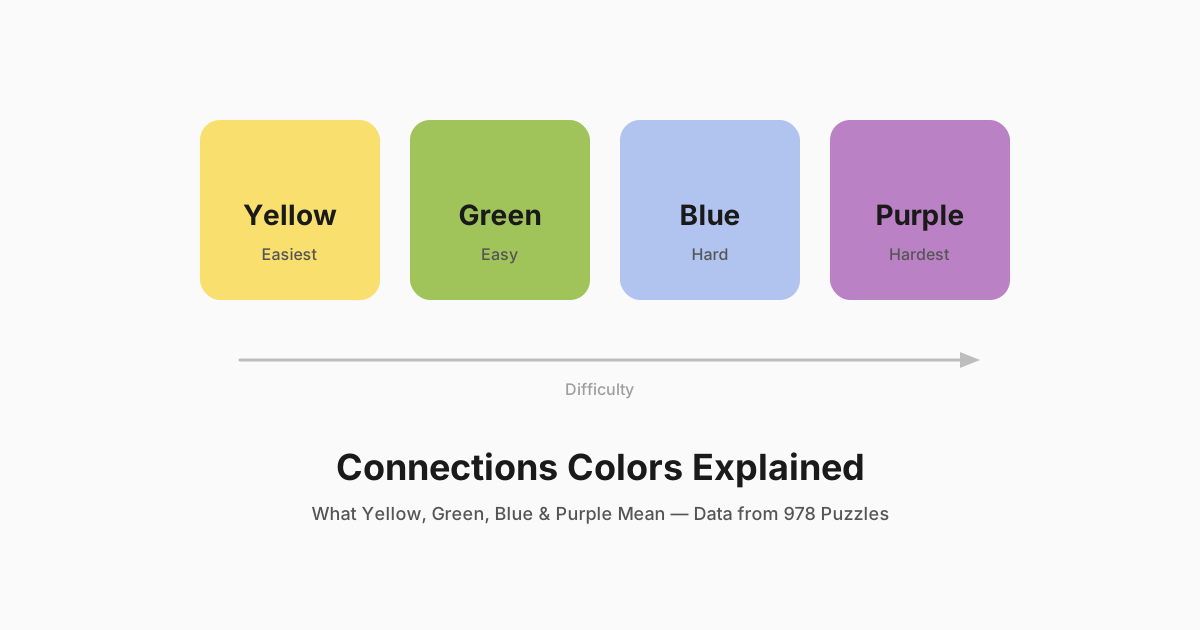
NYT Connections Colors Explained: What Yellow, Green, Blue & Purple Mean
Every NYT Connections puzzle uses four color-coded groups ranked by difficulty. We analyzed 978 puzzles to show exactly what each color means, which categories appear most, and how to use the color system to your advantage.
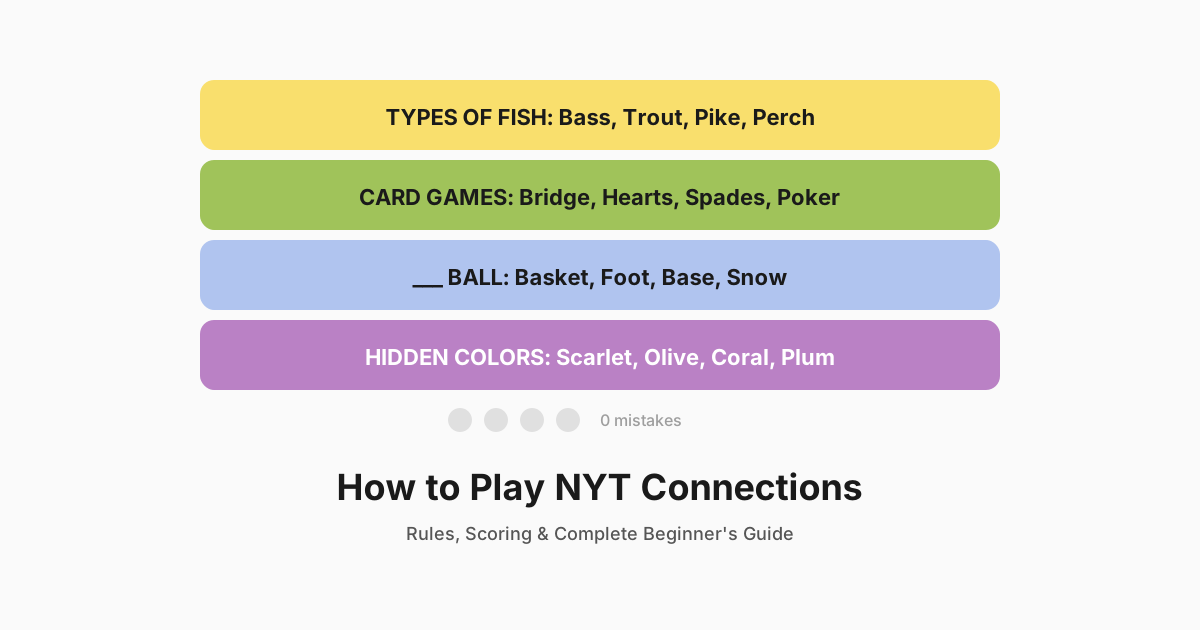
How to Play NYT Connections: Rules, Scoring & Complete Guide
Learn how to play NYT Connections with this complete beginner's guide. Understand the rules, color-coded difficulty system, scoring, and how Connections compares to Wordle, plus tips for your first week.
Need today's Connections hints?
Progressive clues revealed one level at a time, category hints, and full answers.
Today's Connections Hints